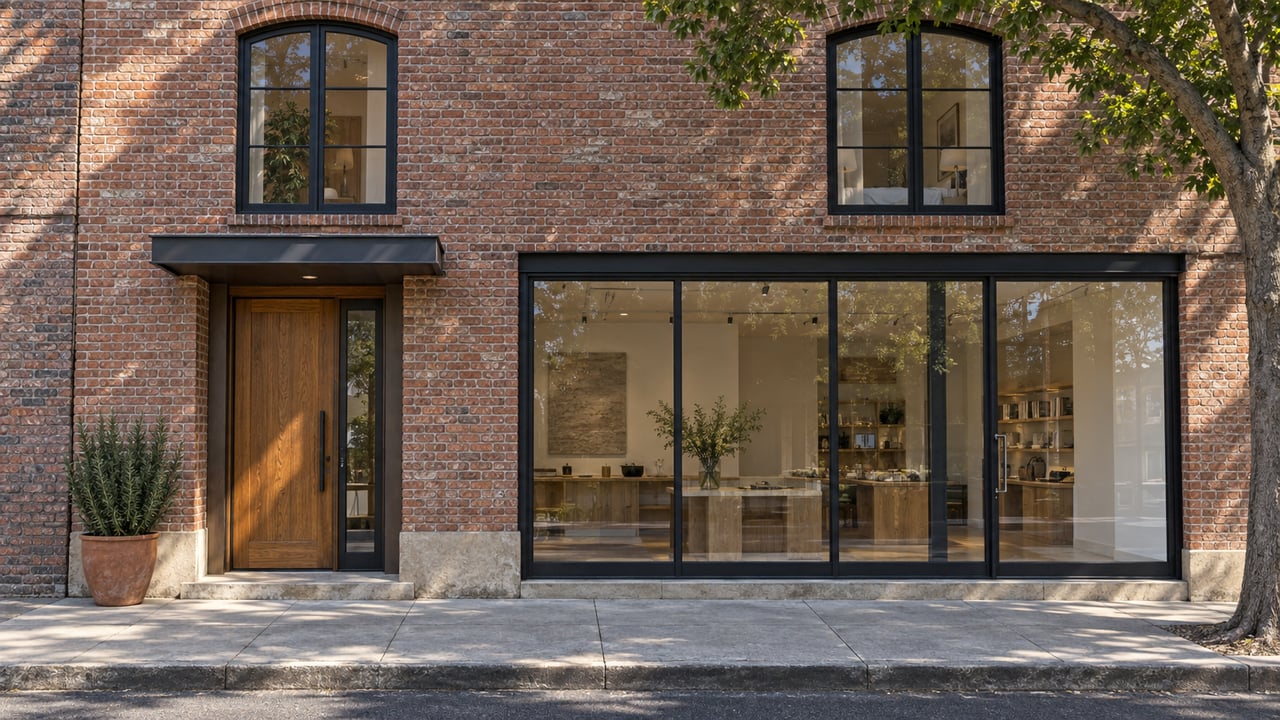
California Avenue Just Filled Four Empty Storefronts. History Explains Why It Was This Six Blocks and Not the Other Downtown.
October 1, 2026
October 1, 2026
What do you call a street that spent a century pretending it was never built for wine, and is now anchored by a bistro with a nearly 300-label list split across French, Californian, and Italian pours? On California Avenue, the answer is simple: you call it Tuesday night.
Four new doors have opened or are about to open within a short walk of the California Avenue Caltrain platform this year, and none of them arrived by accident. The street's retail vacancy dropped hard enough in twelve months that landlords are filling space faster than they can decide what to call the next tenant. And underneath the new menus sits an older story about why this particular stretch of pavement was built to serve alcohol in the first place, back when the rest of Palo Alto legally couldn't.
If you've walked past a dark storefront on Cal Ave sometime in the last year and wondered what was coming, here's the current lineup:
None of these four picked a random block. All four sit within a short walk of the Cal Ave Caltrain stop, which means the new density isn't spreading evenly across the neighborhood. It's stacking in one place.
Here's the number that explains the stacking. As of 2025, California Avenue's retail vacancy rate had been cut roughly in half in a single year, falling from 10 percent to 5.4 percent, according to figures the city provided to Bay Area News Group. University Avenue's vacancy also improved over the same period, but more gradually, going from a decade-high 17.4 percent at the start of 2024 down to 13.4 percent in 2025.
| Corridor | Vacancy start of 2024 | Vacancy in 2025 |
|---|---|---|
| California Avenue | 10% | 5.4% |
| University Avenue | 17.4% | 13.4% |
A landlord filling a storefront on Cal Ave right now is filling it into a noticeably tighter market than a landlord on University. That gap is a reasonable explanation for why a French bistro, a Japanese curry concept, and a matcha cafe all picked the same six blocks in the same twelve months instead of scattering across downtown. Cal Ave isn't just adding restaurants. It's the corridor where space is scarce enough that operators are competing for whatever opens up.
The wine-forward tilt of this year's openings isn't a coincidence of restaurant trends. California Avenue sits on what used to be the separately incorporated town of Mayfield, annexed by Palo Alto in 1925. Mayfield's entire reason for existing as its own town, rather than folding into its neighbor sooner, was that it served alcohol while Palo Alto proper was dry. When the two merged, Mayfield's stretch of California Avenue kept a looser relationship with drinking than the rest of the city ever had.
That history is easy to miss walking past The Rendezvous with its wine flights, or past Bevri, the Georgian restaurant known for orange wines and khachapuri adjaruli bread boats, which shares a parklet with the neighboring restaurant Khazana. Owner Pavel Sirotin has said the food from his kitchen "take[s] on an additional aesthetic quality when they're lit with the natural sunshine in Palo Alto," adding, "we live in California, where the weather is almost always perfect." The sunshine helps sell the outdoor pours, but the street's tolerance for those pours predates the parklets by a century.
The city is now leaning further into that identity on purpose. Officials have discussed allowing open alcohol containers within the closed-to-car zones on California Avenue and Ramona Street, modeling the idea loosely on New Orleans's Bourbon Street. Nothing is finalized, but the direction is consistent with everything else happening on this block: California Avenue isn't discovering a new personality this year. It's returning to the one it had before it was ever required to answer to Palo Alto's rules.
The physical shape of the street changed on June 1, 2026, when the City Council signed off on permanent design standards for the dining structures along the car-free stretch between El Camino Real and Birch Street. Merchants can now choose between two approved models: a cabana with a sloped roof and overhangs, or a pergola with a flat roof.
Both replace an earlier proposal that would have swept the parklets away entirely in favor of open tables and umbrellas, an idea that died after restaurant owners pointed out, correctly, that Palo Alto has rain and wind and customers who don't enjoy eating outside in either. The bike lane question got settled in the same meeting. Rather than building a dedicated two-way bike lane down the center of the street, which merchants worried would encourage cyclists to speed through a pedestrian zone, the plan uses thermoplastic bands laid across the pavement as a traffic-calming surface. Cyclists can still ride through. They're just nudged to slow down first.
There's a construction note worth having if you're deciding which end of California Avenue to favor for a weeknight dinner over the next couple of years. A proposal for the old Mollie Stone's Market site at 156 California Ave, from Redco Development, calls for three residential towers, one at 14 stories and two at 12, after the developer agreed to cut the tallest building down from an original 17 stories following months of negotiation with the city. That construction will concentrate on the west end of the block, near El Camino. The stretch toward Birch Street, where The Rendezvous, DEMI, Rikyu, and eventually Croissanté are clustering, is likely to stay comfortable and walkable through 2027 and 2028 while the west end works through its build-out.
None of this changes what the street is for right now. It changes where you'll want to park, and which direction you'll walk from the Caltrain platform if you're trying to avoid a construction fence on your way to dinner.
The parklets are new. The bakery still hasn't opened. But the reason people are drinking wine on this particular half mile of Palo Alto is close to a hundred years old, and the city just spent a year making the arrangement official again.
If you're weighing what a specific building or block on California Avenue means for a move in either direction, from a San Francisco high-rise to a Peninsula home or the reverse, Highrises2Homes can walk you through it street by street. Schedule a consultation with Leslie Bauer.
Stay up to date on the latest real estate trends.
Home Buying
Home Selling
Home Maintenance

Home Selling
With deep expertise in both high-rise living and single-family homes throughout San Francisco and the Peninsula, our team brings a sharp eye for detail and a thoughtful, data-driven approach—helping you navigate the market with clarity, uncover opportunities others miss, and secure the right property with confidence.
HIGHRISES2HOMES
[email protected]
(415) 205-3899
LESLIE BAUER | CA DRE# 01800943
SIDE, INC. | CA DRE# 02014153
629 DIVISADERO ST SAN FRANCISCO, CA 94117